Transgenic fish and aquaculture
Share
นามธรรม
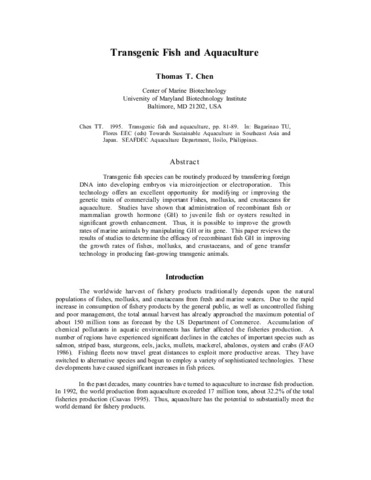
Transgenic fish species can be routinely produced by transferring foreign DNA into developing embryos via microinjection or electroporation. This technology offers an excellent opportunity for modifying or improving the genetic traits of commercially important Fishes, mollusks, and crustaceans for aquaculture. Studies have shown that administration of recombinant fish or mammalian growth hormone (GH) to juvenile fish or oysters resulted in significant growth enhancement. Thus, it is possible to improve the growth rates of marine animals by manipulating GH or its gene. This paper reviews the results of studies to determine the efficacy of recombinant fish GH in improving the growth rates of fishes, mollusks, and crustaceans, and of gene transfer technology in producing fast-growing transgenic animals.
การอ้างอิง
Chen, T. T. (1995). Transgenic fish and aquaculture. In T. U. Bagarinao & E. E. C. Flores (Eds.), Towards Sustainable Aquaculture in Southeast Asia and Japan: Proceedings of the Seminar-Workshop on Aquaculture Development in Southeast Asia, Iloilo City, Philippines, 26-28 July, 1994 (pp. 81-89). Tigbauan, Iloilo, Philippines: Aquaculture Department, Southeast Asian Fisheries Development Center.
เรื่อง

คอลเลกชัน
- ADSEA '94 [21]
รายการที่เกี่ยวข้อง
แสดงรายการที่เกี่ยวข้องตามชื่อผู้แต่งผู้สร้างและเรื่อง
-
Aquaculture in Malaysia
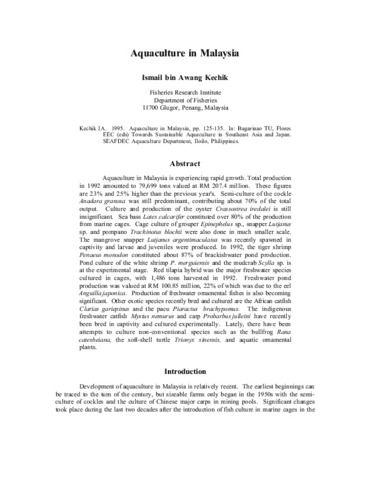
(Aquaculture Department, Southeast Asian Fisheries Development Center, 1995)Aquaculture in Malaysia is experiencing rapid growth. Total production in 1992 amounted to 79,699 tons valued at RM 207.4 million. These figures are 23% and 25% higher than the previous year's. Semi-culture of the cockle ... -
Coastal aquaculture in Thailand
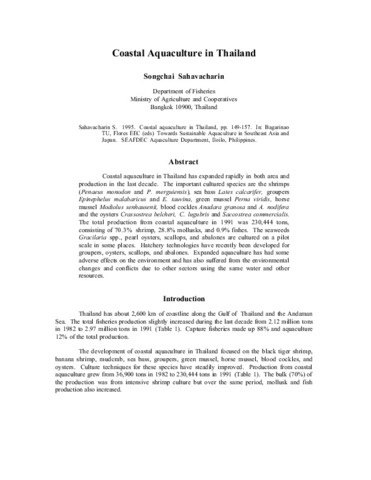
(Aquaculture Department, Southeast Asian Fisheries Development Center, 1995)Coastal aquaculture in Thailand has expanded rapidly in both area and production in the last decade. The important cultured species are the shrimps (Penaeus monodon and P. merguiensis), sea bass Lates calcarifer, groupers ... -
Aquaculture in the Philippines
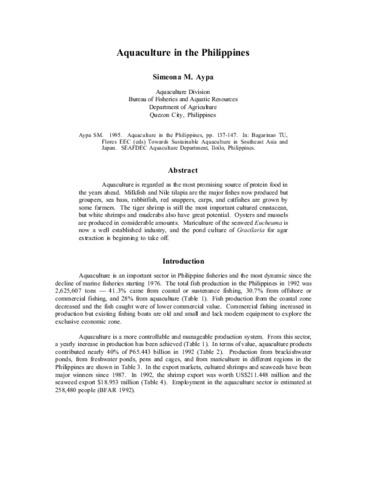
(Aquaculture Department, Southeast Asian Fisheries Development Center, 1995)Aquaculture is regarded as the most promising source of protein food in the years ahead. Milkfish and Nile tilapia are the major fishes now produced but groupers, sea bass, rabbitfish, red snappers, carps, and catfishes ...