Complying with the import provisions of the US Marine Mammal Protection Act (MMPA): Issues and challenges of the ASEAN Member States
ရက်စွဲ
2023-02Page views
1,831Share
စိတ္တဇ
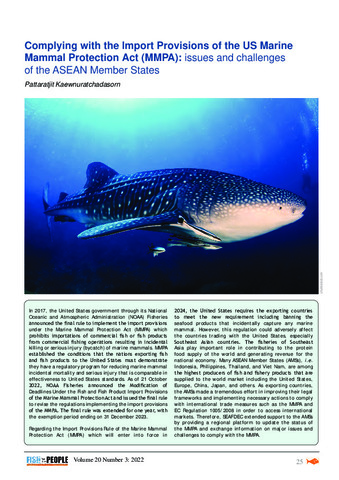
In 2017, the United States government through its National Oceanic and Atmospheric Administration (NOAA) Fisheries announced the final rule to implement the import provisions under the Marine Mammal Protection Act (MMPA) which prohibits importations of commercial fish or fish products from commercial fishing operations resulting in incidental killing or serious injury (bycatch) of marine mammals. MMPA established the conditions that the nations exporting fish and fish products to the United States must demonstrate they have a regulatory program for reducing marine mammal incidental mortality and serious injury that is comparable in effectiveness to United States standards. As of 21 October 2022, NOAA Fisheries announced the Modification of Deadlines Under the Fish and Fish Product Import Provisions of the Marine Mammal Protection Act and issued the final rule to revise the regulations implementing the import provisions of the MMPA. The final rule was extended for one year, with the exemption period ending on 31 December 2023.
Regarding the Import Provisions Rule of the Marine Mammal Protection Act (MMPA) which will enter into force in 2024, the United States requires the exporting countries to meet the new requirement including banning the seafood products that incidentally capture any marine mammal. However, this regulation could adversely affect the countries trading with the United States, especially Southeast Asian countries. The fisheries of Southeast Asia play important role in contributing to the protein food supply of the world and generating revenue for the national economy. Many ASEAN Member States (AMSs), i.e. Indonesia, Philippines, Thailand, and Viet Nam, are among the highest producers of fish and fishery products that are supplied to the world market including the United States, Europe, China, Japan, and others. As exporting countries, the AMSs made a tremendous effort in improving their legal frameworks and implementing necessary actions to comply with international trade measures such as the MMPA and EC Regulation 1005/2008 in order to access international markets. Therefore, SEAFDEC extended support to the AMSs by providing a regional platform to update the status of the MMPA and exchange information on major issues and challenges to comply with the MMPA.
Suggested Citation
Kaewnuratchadasorn, P. (2023). Complying with the import provisions of the US Marine Mammal Protection Act (MMPA): Issues and challenges of the ASEAN Member States. Fish for the People , 20(3), 25-29. http://hdl.handle.net/20.500.12066/7177
ဘာသာရပ်


စုစည်းမှုများ စုစည်းမှုများ
Related items
Showing items related by title, author, creator and subject.
-
Southeast Asian fish products
(Marine Fisheries Research Department, Southeast Asian Fisheries Development Center, 1987)An inventory is presented of fishery products in the Southeast Asia region, listing the fish products available in countries in the region and the technical problems and constraints in meeting market requirements. -
The application of HACCP in the fish processing industry in Southeast Asia, 2000-2003
(Marine Fisheries Research Department, Southeast Asian Fisheries Development Center, 2003)At the 31st SEAFDEC Council Meeting in March 1999, it was proposed that a Japanese Trust Fund Project financed by the Fisheries Agency of Japan be established to support the programmes under the ASEAN-SEAFDEC Fisheries ... -
Fish in the diet
(Aquaculture Department, Southeast Asian Fisheries Development Center, 1990)