Evaluating the Implementation and Impact of FAO’s Voluntary Guidelines for Securing Sustainable Small-scale Fisheries in Southeast Asia and South Asia: Challenges, Progress, and Pathways Forward
Share
Abstract
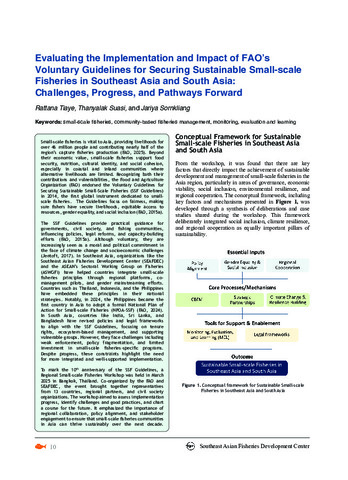
Small-scale fisheries is vital to Asia, providing livelihoods for over 46 million people and contributing nearly half of the region’s capture fisheries production (FAO, 2025). Beyond their economic value, small-scale fisheries support food security, nutrition, cultural identity, and social cohesion, especially in coastal and inland communities where alternative livelihoods are limited. Recognizing both their contributions and vulnerabilities, the Food and Agriculture Organization (FAO) endorsed the Voluntary Guidelines for Securing Sustainable Small-Scale Fisheries (SSF Guidelines) in 2014, the first global instrument dedicated to small-scale fisheries. The Guidelines focus on fairness, making sure fishers have secure livelihoods, equitable access to resources, gender equality, and social inclusion (FAO, 2015a).
The SSF Guidelines provide practical guidance for governments, civil society, and fishing communities, influencing policies, legal reforms, and capacity-building efforts (FAO, 2015a). Although voluntary, they are increasingly seen as a moral and political commitment in the face of climate change and socioeconomic challenges (Jentoft, 2017). In Southeast Asia, organizations like the Southeast Asian Fisheries Development Center (SEAFDEC) and the ASEAN’s Sectoral Working Group on Fisheries (ASWGFi) have helped countries integrate small-scale fisheries principles through regional platforms, co-management pilots, and gender mainstreaming efforts. Countries such as Thailand, Indonesia, and the Philippines have embedded these principles in their national strategies. Notably, in 2024, the Philippines became the first country in Asia to adopt a formal National Plan of Action for Small-scale Fisheries (NPOA-SSF) (FAO, 2024). In South Asia, countries like India, Sri Lanka, and Bangladesh have revised policies and legal frameworks to align with the SSF Guidelines, focusing on tenure rights, ecosystem-based management, and supporting vulnerable groups. However, they face challenges including weak enforcement, policy fragmentation, and limited investment in small-scale fisheries-specific programs. Despite progress, these constraints highlight the need for more integrated and well-supported implementation.
To mark the 10th anniversary of the SSF Guidelines, a Regional Small-scale Fisheries Workshop was held in March 2025 in Bangkok, Thailand. Co-organized by the FAO and SEAFDEC, the event brought together representatives from 13 countries, regional partners, and civil society organizations. The workshop aimed to assess implementation progress, identify challenges and good practices, and chart a course for the future. It emphasized the importance of regional collaboration, policy alignment, and stakeholder engagement to ensure that small-scale fisheries communities in Asia can thrive sustainably over the next decade.
Keywords
small-scale fisheries community-based fisheries management monitoring, evaluation and learningPaksa
Mga koleksyon
Related items
Showing items related by title, author, creator and subject.
-
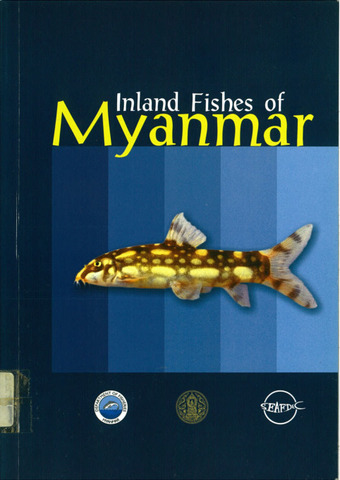
Inland fishes of Myanmar
(Secretariat, Southeast Asian Fisheries Development Center, 2005-12)This handbook of some inland fishes in Myanmar was based on a rapid field survey of SEAFDEC supported team and long term observation of the authors on common species and some taxa, obtained from the aquarium trade. We ...