Socio-economics of oyster and mussel farming in Western Visayas, Philippines
Share
abstrak
Among the economically important bivalves, the slipper oyster (Crassostrea iredalei) and green mussel (Perna viridis) are predominantly being farmed in the Philippines. Oyster and mussel farms in the Western Visayas region have increased because of the need for supplementary sources of income brought about by the dwindling catch of small-scale fishermen. Socio-demographic and costs and returns data were gathered from 175 oyster and mussel farmers using a combination of rapid rural appraisal techniques and a pre-tested questionnaire. Oyster and mussel farms, less than 1000 m2, were located among fish capture devices in rivers and bays. The oyster and mussel farmers belong to the marginalized sector of society with about 30% of total household income derived from oyster and mussel farming. Problems encountered by oyster and mussel farmers included poaching, mortality due to siltation or sedimentation and pond effluents, no spat, lack of financing, and lack of buyers. This study recommends that oyster and mussel farmers form cooperatives to effectively market their produce and avail of financing, and research on the non-occurrence of spat.
Suggested Citation
Samonte, G. P., Siar, S. V., Ortega, R. S., & Espada, L. T. (1994). Socio-economics of oyster and mussel farming in Western Visayas, Philippines. In: Chou, L.M., Munro, A.D., Lam, T.J., Chen, T.W., Cheong, L.K.K., Ding, J.K., Hooi, K.K., Khoo, H.W., Phang, V.P.E., Shim, K.F., Tan, C.H. (eds.). The Third Asian Fisheries Forum. Proceedings of the Third Asian Fisheries Forum, 26-30 October 1992, Singapore. (pp. 1069-1078). Manila, Philippines: Asian Fisheries Society.
Subjek

Taxonomic term

Koleksi
Related items
Showing items related by title, author, creator and subject.
-
Mangrove-associated mollusc research at SEAFDEC/AQD
(Aquaculture Department, Southeast Asian Fisheries Development Center, 2000)Mollusc research at the Aquaculture Department of the Southeast Asian Fisheries Development Center started in 1975 and focused on two commercially important mangrove-associated bivalves, the slipper-shaped oyster (Crassostrea ... -
Molluscan aquaculture in the Philippines: A review
(Springer, 2023-04-25)Molluscs are among the most valuable resources of the Philippines, an archipelagic country of 7,107 islands bounded by 36,000 km of coastline and 26.6 million ha of coastal waters. In 2020, production from mussels and ... -
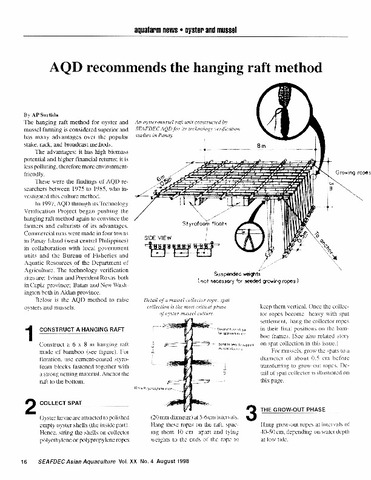
AQD recommends the hanging raft method
(Aquaculture Department, Southeast Asian Fisheries Development Center, 1998)