Incidence and causes of mass fish kill in a shallow tropical eutrophic lake (Laguna de Bay, Philippines)
Share
trừu tượng
Mass fish kills in Laguna de Bay, the largest lake in the Philippines, has been reported as early as in the 1930’s. With the introduction of and development of aquaculture in this lake, considerable attention and concern was focused on the problem. Records of mass fish kill in the lake mainly from unpublished sources and reports from fisherfolk were reviewed and the causes categorized. The data covered the period 1972 to 1998. Among the commercially important fish species affected were milkfish (Chanos chanos), Nile tilapia (Oreochromis niloticus), bighead carp (Aristichthys nobilis), snakehead (Channa striata), catfish (Clarias macrocephalus and C. batrachus, Arius manilensis), silver perch (Terapon plumbeus) and goby (Glossogobius giurus). The first three species are widely used in aquaculture and the rest are important in open water fishery. Sixty percent of mass fish kill incidents were due to low dissolved oxygen with more than half of these cases associated with blue-green phytoplankton blooms. Fish kills due to pollution from agriculture and industries, fish pathogens and other causes are also discussed. The incidence of mass fish kill reached its peak between 1977 to 1986. Records show that the most number of fish kills (80%) occurred between the months of May to September. The lakeshore towns in the central arm of the lake had the highest incidence of fish kill reported with 46% and followed by the west arm of the lake with 38% of all fish kills recorded.
Suggested Citation
Cuvin-Aralar, M. L., Santiago, A. E., Gonzal, A. C., Santiago, C. B., Romana-Eguia, M. R., Baldia, S. F., & Palisoc Jr., F. (2001). Incidence and causes of mass fish kill in a shallow tropical eutrophic lake (Laguna de Bay, Philippines). In 9th International Conference on the Conservation and Management of Lakes. Conference proceedings (pp. 233–236). Shiga, Japan: Shiga Prefectural Government.
Chủ thể
dissolved oxygen  ; plankton blooms ; pollution ; diseases ; geographical distribution ; periodicity ; milkfish ; Nile tilapia ; carp ; Bighead carp; perch ; sea bass ; catfish ; Gobiidae ; tilapia ; Chanos chanos ; Oreochromis niloticus ; Channa striata ; Clarias macrocephalus ; Clarias batrachus ; Bay, Laguna de
; plankton blooms ; pollution ; diseases ; geographical distribution ; periodicity ; milkfish ; Nile tilapia ; carp ; Bighead carp; perch ; sea bass ; catfish ; Gobiidae ; tilapia ; Chanos chanos ; Oreochromis niloticus ; Channa striata ; Clarias macrocephalus ; Clarias batrachus ; Bay, Laguna de
Taxonomic term

Bộ sưu tập
Related items
Showing items related by title, author, creator and subject.
-
1988 annual report
(Aquaculture Department, Southeast Asian Fisheries Development Center, 1989)Since its establishment in 1973, AQD has shown sustained achievements in aquaculture, thus contributing greatly to the progress of the aquaculture industry in the region. Continuing research on prawn culture at AQD has ... -
1989 annual report
(Aquaculture Department, Southeast Asian Fisheries Development Center, 1990)The report describes the activities of the Center during the year 1989 regarding the various research studies conducted, and the training, extension, and information services provided. -
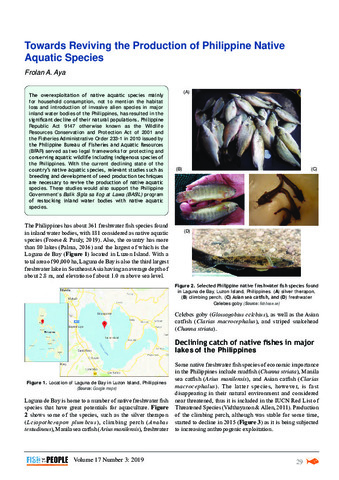
Towards reviving the production of Philippine native aquatic species
(Secretariat, Southeast Asian Fisheries Development Center, 2019)The overexploitation of native aquatic species mainly for household consumption, not to mention the habitat loss and introduction of invasive alien species in major inland water bodies of the Philippines, has resulted in ...