Studies on breeding and seed production of the new species of fish with high commercial value
Share
Abstract
Aquaculture contributes significantly to food production and provides the means to generate increased revenue for countries in Southeast Asia. As the catch from the capture fisheries stagnate and population growth rate in the region continue to be among the highest in the world, the requirement for cheap sources of protein is expected to come from increased production of low trophic level species such as milkfish (Chanos chanos) and tilapia (Oreochromis spp.). There is also an increasing demand for high value fish species such as groupers and snappers particularly for the live food fish markets of affluent and developing countries in Asia. In order to meet the demand for more food fish and to develop new products for the export market, the most important component of any culture system must be met - that of adequate supply of fry and juveniles for culture
Fry availability has been a major constraint in the development of culture systems for new species and in further increasing production of established culture species. The SEAFDEC Aquaculture Department is addressing the problem of fry availability through its research on breeding and seed production of several marine species. To date, commercially viable technologies for breeding and. seed production of milkfish, sea bass (Lates calcarifer) and rabbitfish (Siganus guttatus) have been developed and continue to be refined. Captive breeding and experimental hatchery production of grouper (Epinephelus coiodes) and the mangrove snapper (Lutjanus argentimaculatus) have also been achieved.
Another major focus of SEAFDEC AQD’s research is the development of breeding and seed production technologies of endangered marine species such as the sea horse (Hipocampus spp.) and other marine ornamental fish. The Philippines and other Southeast Asian countries are the major suppliers of marine ornamental fish for the aquarium trade and for medicinal use. These fish species are caught from coral reefs and seagrass beds using destructive fishing techniques such as cyanide fishing that has resulted in the destruction of vast areas of the marine coastal environment. Captive breeding of these endangered species will pave the way for future restocking and conservation programs to ensure their survival.
This paper provides an overview of research accomplishments in marine fish breeding and seed production, current activities, and future directions for research at SEAFDEC AQD.
Subject
food fish  ; milkfish culture ; sea bass culture ; fish culture ; grouper culture ; snapper culture ; breeding ; seed production ; aquarium fishes ; Philippines ; snappers ; Red snapper; Mangrove red snapper; milkfish ; Rabbitfish ; groupers ; sea bass ; Lutjanus argentimaculatus ; Chanos chanos ; Lates calcarifer ; Epinephelus coioides
; milkfish culture ; sea bass culture ; fish culture ; grouper culture ; snapper culture ; breeding ; seed production ; aquarium fishes ; Philippines ; snappers ; Red snapper; Mangrove red snapper; milkfish ; Rabbitfish ; groupers ; sea bass ; Lutjanus argentimaculatus ; Chanos chanos ; Lates calcarifer ; Epinephelus coioides
Taxonomic term

Collections
Related items
Showing items related by title, author, creator and subject.
-
Mass mortality of hatchery-reared milkfish (Chanos chanos) and mangrove red snapper (Lutjanus argentimaculatus) caused by Amyloodinium ocellatum (Dinoflagellida)
(Elsevier, 2004)Outbreaks of heavy infestation by the parasitic dinoflagellate Amyloodinium ocellatum in hatchery-reared milkfish (Chanos chanos) and mangrove red snapper (Lutjanus argentimaculatus) caused 100% mortality events in hatcheries ... -
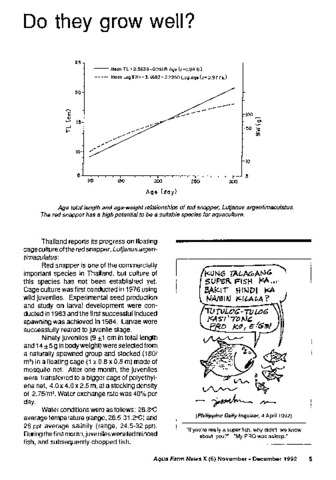
Do they [snappers] grow well?
(Aquaculture Department, Southeast Asian Fisheries Development Center, 1992) -
A hatchery rearing method for the mangrove red snapper
(Aquaculture Department, Southeast Asian Fisheries Development Center, 1997)