Use of thraustochytrid Schizochytrium sp. as source of lipid and fatty acid in a formulated diet for abalone Haliotis asinina (Linnaeus) juveniles
រកមើល / បើក
កាលបរិច្ឆេទ
2016Page views
1,219ទិន្នន័យមេតា
មើលកំណត់ត្រាលម្អិតនៃធាតុCited times in Scopus
Share
អរូបី
The effects of using thraustochytrid Schizochytrium sp. as source of lipid and fatty acids in a formulated diet on growth, survival, body composition, and salinity tolerance of juvenile donkey’s ear abalone, Haliotis asinina, were investigated. Treatments consisted of diets either containing a 1:1 ratio of cod liver oil (CLO) and soybean oil (SBO) (Diet 1) or thraustochytrid (Diet 2) as source of lipid and fatty acids at 2 % level. Natural diet Gracilariopsis heteroclada (Diet 3) served as the control. No significant difference in growth was observed in abalone fed Diet 3 (SGR: 5.3 % BW day−1; DISL: 265 μm day−1) and Diet 2 (SGR: 5.2 % BW day−1; DISL: 255 μm day−1). Survival ranged from 78 to 85 % for all treatments and was not significantly different from each other. A 96-h salinity stress test showed highest survival of 84 % in abalone fed Diet 2 compared with those fed diets 1 and 3 (42 %). The high growth rate of abalone fed Diet 2 and high tolerance to low salinity could be attributed to its high DHA content (8.9 %), which resulted to its high DHA/EPA ratio of 10.5 %. These fatty acids play a significant role in abalone nutrition. The fatty acid profile of abalone meat is a reflective of the fatty acid profile of the oil sources in the diet. The present study suggests that the use of Schizochytrium oil in lieu of CLO and SBO can support good growth of abalone which is comparable with abalone fed the natural seaweeds diet.
Suggested Citation
de la Peña, M. R., Teruel, M. B., Oclarit, J. M., Amar, M. J. A., & Ledesma, E. G. T. (2016). Use of thraustochytrid Schizochytrium sp. as source of lipid and fatty acid in a formulated diet for abalone Haliotis asinina (Linnaeus) juveniles. Aquaculture International , 24(4), 1103-1118. https://doi.org/10.1007/s10499-016-9974-3
ប្រធានបទ
Taxonomic term
បណ្តុំបណ្តុំ
- AQD Journal Articles [1249]
Related items
Showing items related by title, author, creator and subject.
-
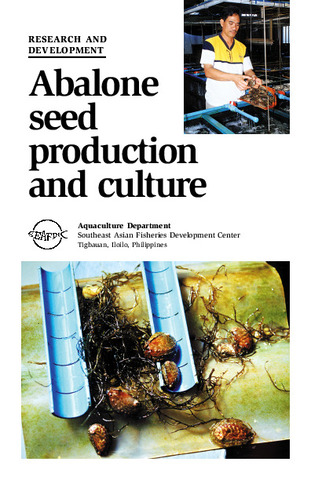
Abalone seed production and culture
(Aquaculture Department, Southeast Asian Fisheries Development Center, 2000)Details the research conducted at AQD for the tropical abalone Haliotis asinina. AQD has developed the rudiments of a hatchery protocol. -
Evolution of genome size within the genus Haliotis (Vetigastropoda: Haliotidae)
(National Shellfisheries Association, 2018)Genome size (C-value) and the percentage of adenine and thymine nucleotides in the genome (AT content) are fundamental characteristics of every species, and very important parameters in molecular cytogenetic and phylogenic ... -
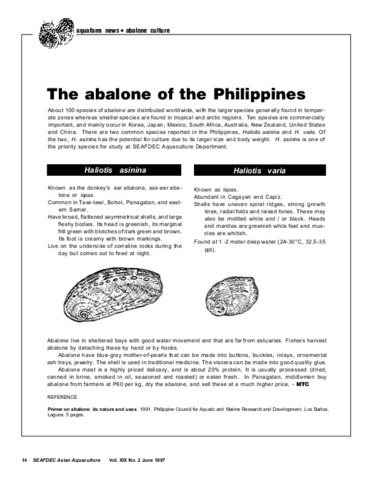
The abalone of the Philippines
(Aquaculture Department, Southeast Asian Fisheries Development Center, 1997)