Fisheries of inland water bodies in Malaysia
Share
Abstract
Lotic waters dominate the Malaysian aquatic environment. There are very few natural lakes in Malaysia. There are only two principal lenthic environments in Malaysia. They are Tasek Chini and the Tasek Bera/Tasek Dampar complex. Both of these lakes located in Pahang, are relatively small in size. Tasik Bera is more of a freshwater swamp than a true lake, covered with stands of littoral, floating, emergent and submerge vegetation, such as Lepironia articulata and Pandanus helicopus, and very few truly open water spaces (Furtado & Mori, 1982). They reported 95 species of fishes from Tasik Bera. Almost all of these species were endemic to Peninsular Malaysia. They also highlighted the difficulties of estimating fish abundance in Tasik Bera because of the small size of fish, presence of large numbers of refuges where the fish are inaccessible and the low intensity of fish catches by the natives.
Suggested Citation
Khoo, K. H., Amir, S. R. M. S., & Ali, A., B,. (2004). Fisheries of inland water bodies in Malaysia. In M. M. Isa (Ed.), Report of the First ASEAN-SEAFDEC Regional Technical Consultation on Information Gathering for Inland Capture Fisheries in ASEAN Countries, Kuala Lumpur, 4-6 August 2003 (pp. 69-83). Kuala Terengganu, Malaysia: Marine Fishery Resources Development and Management Department, Southeast Asian Fisheries Development Center.
Paksa

Related items
Showing items related by title, author, creator and subject.
-
Highlighting the importance of inland capture fisheries in the Southeast Asian region
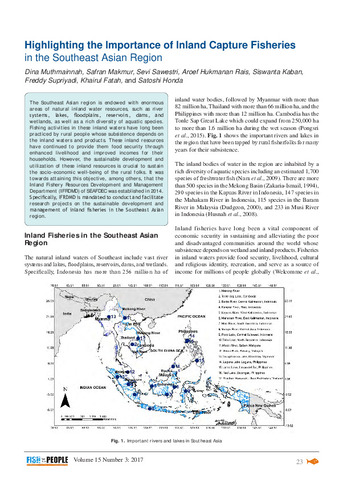
(Secretariat, Southeast Asian Fisheries Development Center, 2017)The Southeast Asian region is endowed with enormous areas of natural inland water resources, such as river systems, lakes, floodplains, reservoirs, dams, and wetlands, as well as a rich diversity of aquatic species. Fishing ... -
Inland fisheries resource enhancement and conservation practices in Myanmar
(Aquaculture Department, Southeast Asian Fisheries Development Center, 2015)Myanmar has impressive freshwater capture fisheries. Inland freshwater bodies cover 8.1 million ha of which 1.3 million ha are permanent while the rest are seasonally inundated floodplains. There are repeated references ... -
Status of Fishing Conditions in Cambodia
(Training Department, Southeast Asian Fisheries Development Center, 1997)Fisheries in plays a very important role in Cambodia’s national economic development. Total fish catch production in 1996 was 104 310 tones, about which 60% was contributed by inland capture fisheries, 30% by marine capture ...