Practices and economics of successful shrimp farms in the Philippines
Share
Abstract
After reaching a production of 90,426 mt in 1994, production of black tiger shrimp (Penaeus monodon) in the Philippines has slowly declined and has dropped to only 35,493 mt, the lowest since 1987. Amidst the production failures besetting most of the farms in the country, a few farms man- aged to turn around once again and operate profitably with some even expanding their operations and are the subject of this study covering 40 farms. The common characteristics of the successful farms were found to be as follows: (a) easy access to clean seawater due to relatively deep nature of the shoreline, availability of saltwater from well, or adequate reservoir area to treat new water; (b) clean and compact pond bottom either because these are located above the tidal level or have been backfilled heavily with crushed limestone; (c) use of healthy fry by ascertaining fry condition through proper diagnostics; (d) adequate aeration; (e) good feed management; (f) use of bioreme- diators such as microbial inoculants (often referred to as probiotics), fish or both; (g) long dry-out period or alternating shrimp with tilapia or milkfish effectively limiting shrimp production to only one crop per year; and (h) adequate production-based incentives to technicians and workers. When standardized into 5 ha farms under three stocking density conditions, the economic performances are as follows at density levels of 5/m2, 15/m2, and 40/m2, respectively. The returns on investment (ROI) are 106.7%, 66.0%, and 78.5%; the internal rates of return (IRR) 250%, 111%, and 142%; and finally a return on equity (at a loan/equity of 70:30) 355.8%, 220.1%, and 261.8%.
Suggested Citation
Yap, W. G., & Villaluz, A. C. (2006). Practices and economics of successful shrimp farms in the Philippines. In P. Leung & C. Engle (Eds.), Shrimp Culture: Economics, Market, and Trade (pp. 223–238). Wiley. https://doi.org/10.1002/9780470277850.ch15
Paksa


Taxonomic term

Mga koleksyon
Related items
Showing items related by title, author, creator and subject.
-
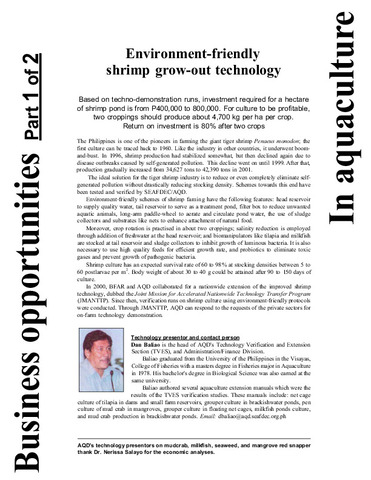
Environment-friendly shrimp grow-out technology
(Aquaculture Department, Southeast Asian Fisheries Development Center, 2003) -
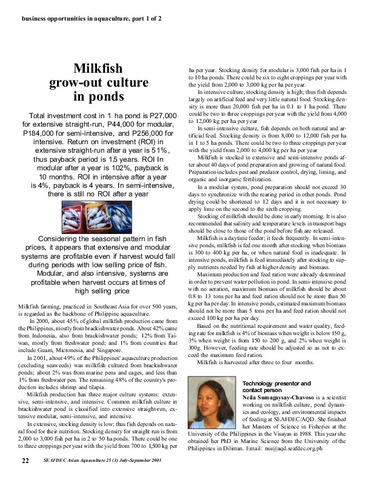
Milkfish grow-out culture in ponds
(Aquaculture Department, Southeast Asian Fisheries Development Center, 2003)Milkfish farming is regarded as the backbone of Philippine aquaculture. In 2001, nearly 50% of the Philippines' aquaculture production was milkfish cultured from brackishwater ponds. It has 3 major culture systems: extensive; ... -
Abdominal segment deformity syndrome (asds) and fused body segment deformity (fbsd) in cultured Penaeus indicus
(Elsevier, 2017)The abdominal segment deformity disease (ASDD) is a new shrimp disease reported only in cultured Penaeus vannamei in Thailand. Shrimp with ASDD have deformed abdominal segment, jagged gut line and bumpy surfaces. Similar ...