SEAFDECINSTITUTIONAL REPOSITORY
    • English
    • ไทย
    • 日本語
    • Bahasa Indonesia
    • Bahasa Melayu
    • Burmese
    • Filipino
    • Khmer
    • Lao
    • Tiếng Việt
  • Filipino 
    • English
    • ไทย
    • 日本語
    • Bahasa Indonesia
    • Bahasa Melayu
    • Burmese
    • Filipino
    • Khmer
    • Lao
    • Tiếng Việt
  • Mag log in
Tingnan ang Item 
  •   DSpace Home
  • 08 SEAFDEC/MFRD Publications
  • 02 Technical Publications and Reports on Fish Handling and Post-harvest Practices
  • Enhancing Quality and Safety of Fish Products
  • Hazard Analysis and Critical Control Point (HACCP)
  • The Application of HACCP in the Fish Processing Industry in Southeast Asia 2000-2003
  • Tingnan ang Item
  •   DSpace Home
  • 08 SEAFDEC/MFRD Publications
  • 02 Technical Publications and Reports on Fish Handling and Post-harvest Practices
  • Enhancing Quality and Safety of Fish Products
  • Hazard Analysis and Critical Control Point (HACCP)
  • The Application of HACCP in the Fish Processing Industry in Southeast Asia 2000-2003
  • Tingnan ang Item
JavaScript is disabled for your browser. Some features of this site may not work without it.

The application of HACCP in the fish processing industry in Southeast Asia, 2000-2003: Indonesia
Thumbnail
Tingnan/Open
PDF Preview
indonesia2003.pdf (191.4Kb)
Downloads: 268
Petsa
2003
May-akda
Mangunsong, Setia
Page views
664
Metadata
Ipakita ang buong tala ng item

Share 
 
Abstract
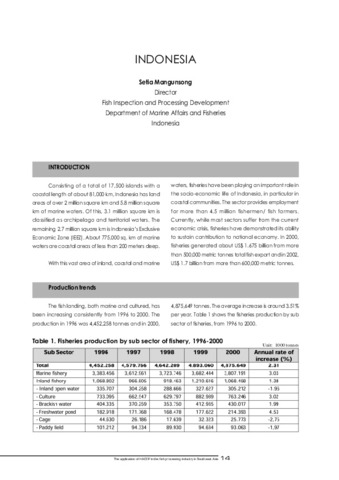
Consisting of a total of 17,500 islands with a coastal length of about 81,000 km, Indonesia has land areas of over 2 million square km and 5.8 million square km of marine waters. Of this, 3.1 million square km is classified as archipelago and territorial waters. The remaining 2.7 million square km is Indonesia’s Exclusive Economic Zone (IEEZ). About 775,000 sq. km of marine waters are coastal areas of less than 200 meters deep. With this vast area of inland, coastal and marine waters, fisheries have been playing an important role in the socio-economic life of Indonesia, in particular in coastal communities. The sector provides employment for more than 4.5 million fishermen/ fish farmers. Currently, while most sectors suffer from the current economic crisis, fisheries have demonstrated its ability to sustain contribution to national economy. In 2000, fisheries generated about US$ 1.675 billion from more than 500,000 metric tonnes total fish export and in 2002, US$ 1.7 billion from more than 600,000 metric tonnes. [Extract]
URI
http://hdl.handle.net/20.500.12066/4736
Suggested Citation
Mangunsong, S. (2003). Indonesia. In S. E. Yeap & I. Hariono (Eds.), The Application of HACCP in the Fish Processing Industry in Southeast Asia 2000-2003 (pp. 14-25). Singapore: Marine Fisheries Research Department, Southeast Asian Fisheries Development Center.
Paksa
processing fishery products ASFA; fish consumption ASFA; Fish inspection; quality control ASFA; legislation ASFA; jurisdiction ASFA; Fishery industry; fishery products ASFA; seafoods ASFA; fisheries development ASFA; fishery management ASFA; products ASFA; Indonesia
Mga koleksyon
  • The Application of HACCP in the Fish Processing Industry in Southeast Asia 2000-2003 [11]

Related items

Showing items related by title, author, creator and subject.

  • Thumbnail

    Southeast Asian fish products 

    Ng, Mui Chng; Hooi, Kok Kuang; Miwa, Katsutoshi (Marine Fisheries Research Department, Southeast Asian Fisheries Development Center, 1991)
    This report is a comprehensive record of fish products in the region, and will be of interest to researchers, food scientists, fish technologists and administrators. It will also be useful for fish traders, and may be used ...
  • Thumbnail

    Southeast Asian fish products 

    Ng, Mui Chng; Chia, Evelyn Geok Hoon; Lee, How Kwang (Marine Fisheries Research Department, Southeast Asian Fisheries Development Center, 1996)
    This book is based on an ASEAN wide survey of products processed and consumed in the region. The participating countries are Brunei Darussalam, Indonesia, Malaysia, Philippines, Singapore, Thailand and Vietnam. Results ...
  • Thumbnail

    Southeast Asian fish products 

    Kok, Tiong Ngei; Yeap, Soon Eong; Hariono, Ira; Theng, Chevonne Ang Guat (Marine Fisheries Research Department, Southeast Asian Fisheries Development Center, 2002)
    This book is based on an ASEAN wide survey of products processed and consumed in the region. The participating countries are Brunei Darussalam, Indonesia, Malaysia, Philippines, Singapore, Thailand and Vietnam. Results ...

© SEAFDEC 2025
Makipag-ugnayan sa amin


Mag-browse

Lahat ng DSpaceMga Komunidad at KoleksyonAyon sa Petsa ng IsyuMga may-akdaMga pamagatMga paksaAng Koleksyon na itoAyon sa Petsa ng IsyuMga may-akdaMga pamagatMga paksa

Aking Account

Mag log in
Related Links
SEAFDEC/TD IRSEAFDEC/AQD IRSEAFDEC/MFRDMD IRSEAFDEC/IFRDMD IR

© SEAFDEC 2025
Makipag-ugnayan sa amin


DOWNLOAD