Mangroves, fishponds, and the quest for sustainability
Associated URL
www.sciencemag.orgNgày
2005Page views
589metadata
Hiển thị bản ghi đầy đủ mặt hàngCited times in Scopus
Share
trừu tượng
Aquaculture, the farming of shrimp and other useful aquatic and marine plants and animals in artificially confined and tended ponds, pens, and cages, ranks as a phenomenal success story in global food production. In 1975, aquaculture contributed 8% to the overall yield of the world's fish harvest; now it provides more than one-third of the yield. Total aquaculture production in 2003 was 54.8 million metric tons valued at $67.3 billion in U.S. dollars. More than 90% of this output comes from Asia, where aquaculture has its origins and where this month's essay author has lived and worked all of her life. In her essay, Jurgenne H. Primavera, senior scientist of the Aquaculture Department of the Southeast Asian Fisheries Development Center based in Iloilo, Central Philippines, traces the recent history of aquaculture and the socioeconomic and environmental challenges that its rapid growth has wrought, especially for the mangrove ecosystems in which much of brackishwater pond aquaculture occurs. With an eye on all stakeholders, Primavera lays out how aquaculture is now falling short of the goal of sustainability and what steps might be taken to move the industry in that direction.
Suggested Citation
Primavera, J. (2005). Mangroves, fishponds, and the quest for sustainability. Science , 310(5745), 57-59. https://doi.org/10.1126/science.1115179
Chủ thể
Bộ sưu tập
- AQD Journal Articles [1249]
Related items
Showing items related by title, author, creator and subject.
-
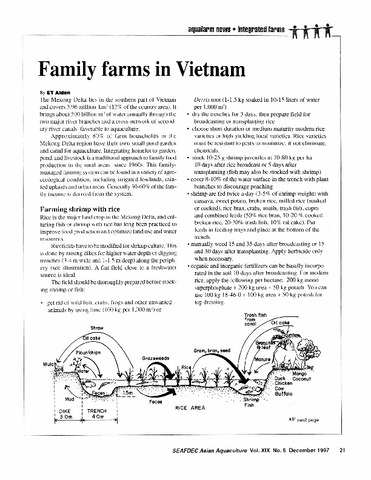
Family farms in Vietnam
(Aquaculture Department, Southeast Asian Fisheries Development Center, 1997) -
The Philippine aquaculture industry
(Aquaculture Department, Southeast Asian Fisheries Development Center, 1988)The aquaculture sector of the Philippine fishing industry registered the highest growth rate of 12.5% in 1977-1986. The contribution of aquaculture to the total fish production was equivalent to 24% in 1986 compared to ... -
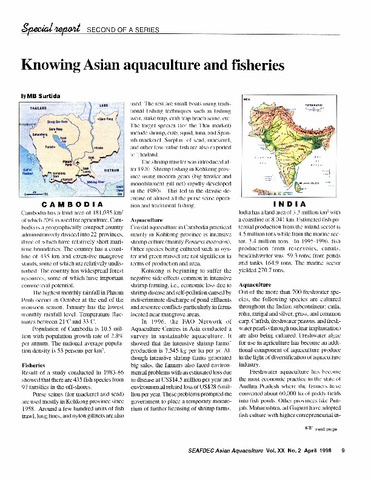
Knowing Asian aquaculture and fisheries
(Aquaculture Department, Southeast Asian Fisheries Development Center, 1998-04)This article is the second of four parts.