Large scale hatchery production of Penaeus monodon using natural food and artificial diets
Share
abstrak
Natural food in combination with either SEAFDEC formulated or other commercial larvae diets was tested for large scale production of Penaeus monodon postlarvae. Two trials of 3 treatments each, 2 replications of each treatment, were conducted in 10 m3 circular concrete tanks. Shrimps were reared from nauplii to postlarvae. Dietary treatments for trial I included:(a) natural food (NF) alone, (b) NF+ commercial plankton substitute (PS) and (c) NF+ SEAFDEC diet (SD).For trial II, commercial powder diets SP or SMP were added:(a) NF + SP, (b) NF + PS + SP + SMP and (c) NF + SD + SP + SMP. Larvae survival was significantly higher in treatments containing the SEAFDEC diets than in the treatments receiving natural food alone (trial I) or natural food in combination with SP (trial II). Larval development was faster in the group fed the SEAFDEC diet; larvae in these groups metamorphosed into postlarvae an average of 1-2 days earlier than groups fed other diets. The presence of either SP or SMP did not improve the efficiency of the feeds. Results showed that larvae performance was affected by the nutrient composition of the diets and that by using proper feeding techniques and management of water quality, large scale hatchery production of P. monodon using natural food in combination with the SEAFDEC diet or plankton substitute is possible.
Suggested Citation
Bautista, M. N., Parado-Estepa, F., Millamena, O. M., & Borlongan, E. L. (1991). Large scale hatchery production of Penaeus monodon using natural food and artificial diets. The Israeli Journal of Aquaculture-Bamidgeh , 43(4), 137-144. http://hdl.handle.net/10862/1232
Subjek

Taxonomic term

Koleksi
- AQD Journal Articles [1249]
Related items
Showing items related by title, author, creator and subject.
-
An overview of the nutrition, feed and feeding techniques of prawn penaeid/shrimps
(Philippine Council for Aquatic and Marine Research and Development, 1989)This paper echoes what transpired during the first International Conference of Penaeid Prawns/Shrimps held in Iloilo City in December 4-7, 1984, particularly on the Nutrition nd Feed Development. Around 25 papers were ... -
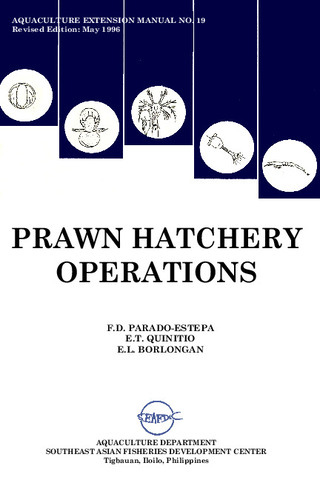
Prawn hatchery operations
(Aquaculture Department, Southeast Asian Fisheries Development Center, 1996-05)The manual, an updated version of the 1984 SEAFDEC/AQD manual, presents the underlying principles and step-by-step instructions of prawn larval and post-larval rearing. The techniques described are not only applicable to ... -
The lowdown on world shrimp culture - II
(INFOFISH, 2001)This paper introduces some new members of the international shrimp culture club and goes on to discuss some recent technological innovations in the industry, particularly the polyculture of tilapia (mainly Oreochromis ...