Broodstock management and egg production of milkfish, Chanos chanos Forsskal
Share
Abstract
The milkfish, Chanos chanos Forsskal, industry in the Philippines suffers from a limited supply of wild fry. The demand for milkfish fry has spurred research in artificial propagation to supplement the natural seed supply. Spontaneous maturation and spawning of milkfish beginning at 5 years of rearing in floating net cages or concrete tanks coupled with improved egg collection technique have increased daily egg collection to a maximum of 3 million eggs and provided adequate volumes of eggs for mass fry production. Annual egg collection and number of spawnings were markedly higher in cage-reared stocks older than 9 years old than stocks less than 9 years old. Egg collection of tank-reared stocks were comparable to those collected in cages. As feed constitutes a major portion of the operating expenses for establishing and maintaining milkfish broodstock, further studies must be geared towards defining optimum dietary requirements and ration size for gonadal maturation and spawning. Also environmental manipulation studies must be conducted for year-round spawning. Developments in these areas should ensure the production of maximum numbers of high quality eggs and fry year-round.
Suggested Citation
Emata, A. C., & Marte, C. L. (1993). Broodstock management and egg production of milkfish, Chanos chanos Forsskal. Aquaculture Research , 24(3), 381-388. https://doi.org/10.1111/j.1365-2109.1993.tb00561.x
Subject
Taxonomic term
Koleksi
- AQD Journal Articles [1249]
Related items
Showing items related by title, author, creator and subject.
-
Small-scale freshwater aquaculture development: Experiences from the Philippines on giant freshwater prawn, milkfish and tilapia
(Japan International Cooperation Agency, 2013-12)The Aquaculture Department of the Southeast Asian Fisheries Development Center (SEAFDEC/AQD) has been promoting a number of programs towards effective dissemination and adoption of science-based aquaculture technologies ... -
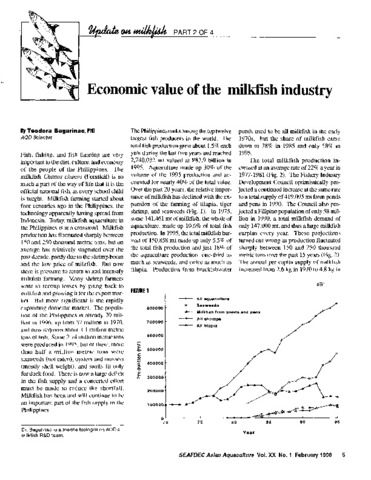
Economic value of the milkfish industry
(Aquaculture Department, Southeast Asian Fisheries Development Center, 1998)A brief description is given of the milkfish (Chanos chanos) farming industry in the Philippines. Over the past 20 years, the relative importance of milkfish has declined with the expansion of tilapia, tiger shrimp and ... -
Milkfish ponds from mangroves
(Aquaculture Department, Southeast Asian Fisheries Development Center, 1998)