Elemental sulfur in the gills of the mangrove mud clam Anodontia edentula (Family Lucinidae)
Share
abstrak
Different sizes of the mangrove mud clam Anodontia edentula were collected from the mangroves in Brgy. San Roque in Estancia, Iloilo, central Philippines, and the mantle, gill, and foot tissues were analyzed for elemental sulfur content. Mangrove mud (substrate) was also analyzed for total sulfur content to establish the possibility of clam-bacteria symbiosis in this lucinid clam. Sulfur analysis showed highly significant (p <0.0001) amounts of elemental sulfur in the gills (247.64 ± 63.28 μmoles/g FW) compared with the quantities observed in the mantle (0.84 ± 0.22 μmoles/g FW). Elemental sulfur was absent from the foot tissues. Results also showed a significantly (p <0.05) decreasing elemental sulfur from the newly collected clams (mean = 461.18 μmoles/g FW) compared to those reared in the laboratory (mean = 159.08 μmoles/g FW: with mangrove mud substrate; mean = 45.18 μmoles/g FW without substrate), which were analyzed weekly until week 3, indicating that stored elemental sulfur is being utilized by the bacteria in the absence of sulfide. Total sulfur content of mangrove mud in situ was higher than that used us substrate in the experiment; where there were no significant differences from initial to final readings. This shows that mangrove mud in situ is linked to a steady sulfur source.
Keywords
Toothless platter shell mangrove mud clam Anodontia edentula lucinid gills elemental sulfur mangrove clam imbaoSuggested Citation
Lebata, J. H. L. (2000). Elemental sulfur in the gills of the mangrove mud clam Anodontia edentula (Family Lucinidae). Journal of Shellfish Research , 19(1), 241-245. http://hdl.handle.net/10862/1857
Subjek
Taxonomic term
Koleksi
- AQD Journal Articles [1249]
Related items
Showing items related by title, author, creator and subject.
-
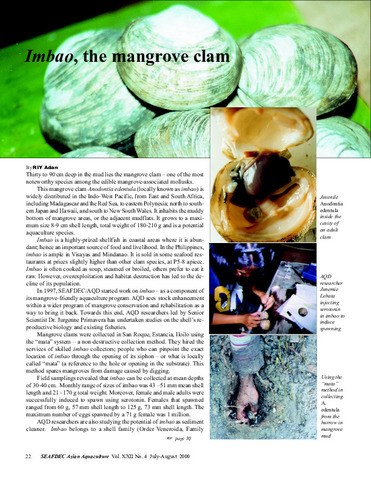
Imbao, the mangrove clam
(Aquaculture Department, Southeast Asian Fisheries Development Center, 2000) -
Collection of the clam Anodontia edentula in mangrove habitats in Panay and Guimaras, central Philippines
(Kluwer Academic Publishers, 2002)The mangrove clam Anodontia edentula is highly prized in the Philippines for its flavor and large size. Because this infaunal species is found down to one meter deep in mangrove areas, harvesting the clam reportedly damages ... -
Gill structure, anatomy and habitat of Anodontia edentula: Evidence of endosymbiosis
(National Shellfisheries Association, 2001)Surveys and interviews were conducted to determine sources and habitat of Anodontia edentula. Results showed that they inhabit muddy substrate of mangrove areas or the adjacent mudflats, burying at 20-60 cm deep in the ...