Cysteine concentration regulates cysteine metabolism to glutathione, sulfate and taurine in rat hepatocytes
Share
Abstract
The effect of cysteine concentration and cysteine source [cysteine, methionine or 2-oxo-thiazolidine-4-carboxylate (OTC)] on the metabolism of [35S]cysteine was studied in isolated rat hepatocytes. Production of each of the major metabolites of cysteine (glutathione, sulfate, taurine) increased as cysteine or methionine, but not OTC, concentration in the medium was increased. At equimolar exogenous substrate concentrations, cysteine availability to hepatocytes was greater from exogenous cysteine than from methionine, and that from methionine was greater than from OTC. The partitioning of cysteine, or the percentage of total metabolism resulting in production of each of the major metabolites, was markedly affected by cysteine concentration or availability. Low cysteine availability favored its utilization for glutathione; high cysteine availability favored its catabolism to sulfate and taurine. Under conditions of low cysteine availability (incubations with 0.2 mmol/L OTC), glutathione, sulfate and taurine production accounted for 90, 10 and 1%, respectively, of total metabolism. Under conditions of high cysteine availability (incubations with 1 mmol/L cysteine + bathocuproine disulfonate), glutathione, sulfate and taurine production accounted for 19, 47 and 34%, respectively, of total metabolism. Cysteine supplied as such and cysteine formed intracellularly from methionine were similarly partitioned. These studies demonstrate that methionine is not a superior substrate to cysteine for hepatic glutathione synthesis and that cysteine concentration (presumably intracellular cysteine concentration) has a major effect on the partitioning of cysteine sulfur to taurine in rat hepatocytes.
Suggested Citation
Stipanuk, M. H., Coloso, R. M., Garcia, R. A. G., & Banks, M. F. (1992). Cysteine concentration regulates cysteine metabolism to glutathione, sulfate and taurine in rat hepatocytes. Journal of Nutrition , 112(3), 420-427. http://hdl.handle.net/10862/1397
Mga koleksyon
- AQD Journal Articles [1249]
Related items
Showing items related by title, author, creator and subject.
-
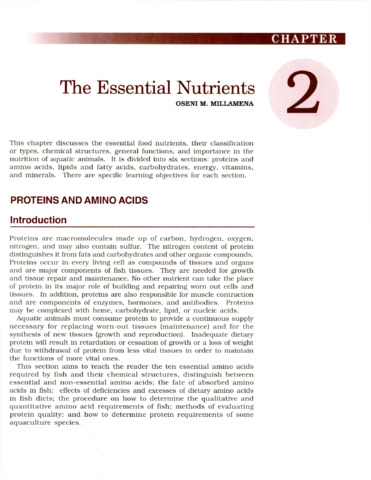
The essential nutrients: Proteins and amino acids
(Aquaculture Department, Southeast Asian Fisheries Development Center, 2002)This section aims to teach the reader the ten essential amino acids required by fish and their chemical structures, distinguish between essential and non-essential amino acids; the fate of absorbed amino acids in fish; ... -
Expression and purification of a biologically active recombinant rabbitfish (Siganus guttatus) growth hormone
(Elsevier, 2005)Recombinant rabbitfish growth hormone (rfGH) protein was expressed in Escherichia coli, BL21(DE3) cells. The cDNA encoding the mature protein of rfGH was first cloned in pGEM-Teasy vector and then transferred to pET-3d ... -
Isolation, cDNA cloning, and growth promoting activity of rabbitfish (Siganus guttatus) growth hormone
(Elsevier, 2000)We report the isolation, cDNA cloning, and growth promoting activity of rabbitfish (Siganus guttatus; Teleostei; Perciformes; Siganidae) growth hormone (GH). Rabbitfish GH was extracted from pituitary glands under alkaline ...