Shell marking by artificial feeding of the tropical abalone Haliotis asinina Linne juveniles for sea ranching and stock enhancement
Share
ບົດຄັດຫຍໍ້
A method of marking abalone (Haliotis asinina Linne) for sea ranching and stock enhancement purposes was developed. Three-month-old abalone juveniles (11.8-mm shell length, 0.28 g) were fed artificial diets for 1, 2, or 3 weeks. The width of the bluish-green shell band produced by abalone juveniles was 1.7, 2.6, and 4.2 mm after 1, 2, or 3 weeks of feeding respectively. The growth and survival of juveniles fed artificial diets did not differ from that of juveniles fed the seaweed Gracilariopsis bailinae (control). Feeding the diet-fed juveniles with the seaweed thereafter produced the natural brownish shell, thus forming a sandwiched bluish-green band. An experimental release in outdoor tanks with natural growth of seaweeds and diatoms, and in a marine reserve showed that the shell band remained clear and distinct, indicating the usefulness of this shell marking method in sea ranching and stock enhancement of abalone.
Suggested Citation
Gallardo, W. G., Bautista-Teruel, M. N., Fermin, A. C., & Marte, C. L. (2003). Shell marking by artificial feeding of the tropical abalone Haliotis asinina Linne juveniles for sea ranching and stock enhancement. Aquaculture Research , 34(10), 839-842. https://doi.org/10.1046/j.1365-2109.2003.00890.x
ວິຊາ
Taxonomic term
Collections
- AQD Journal Articles [1249]
Related items
Showing items related by title, author, creator and subject.
-
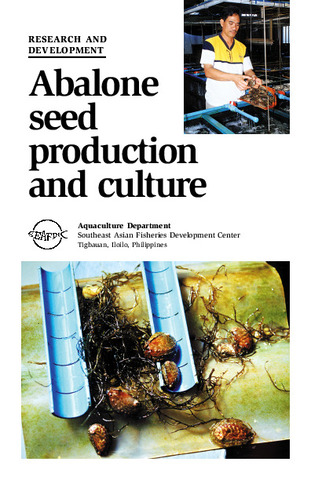
Abalone seed production and culture
(Aquaculture Department, Southeast Asian Fisheries Development Center, 2000)Details the research conducted at AQD for the tropical abalone Haliotis asinina. AQD has developed the rudiments of a hatchery protocol. -
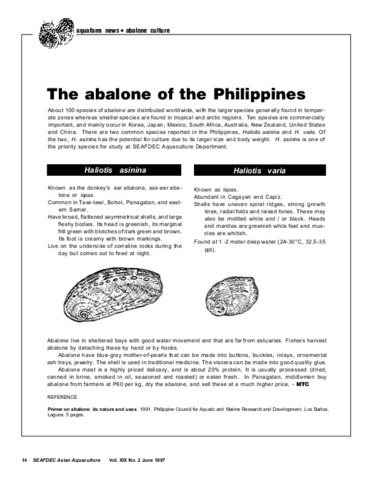
The abalone of the Philippines
(Aquaculture Department, Southeast Asian Fisheries Development Center, 1997) -
Community-based Stock Enhancement of Abalone, Haliotis asinina in Sagay Marine Reserve: Achievements, Limitations and Directions
(Training Department, Southeast Asian Fisheries Development Center, 2016)The Sagay Marine Reserve (SMR) under the National Integrated Protected Area System (NIPAS) is one of the many reef areas in the Visayan Sea in the central part of the Philippine archipelago. The SMR covers 32,000 ha or 59% ...