Comparing profits from shrimp aquaculture with and without green-water technology in the Philippines
Share
นามธรรม
To reduce disease impact, Philippine farmers developed the green-water (GW) system, which has been spreading rapidly since 2008. In the most applied GW-system, the shrimp pond receives water from a reservoir stocked with tilapia. We collected financial data on GW and non-GW systems from farms having similar management and environmental context. All farms had more than one pond; the average pond area was < 1 ha, and total pond areas per farm ranged from 1.4 to 139 ha. The total variable and fixed costs per ha of shrimp pond were not different for GW and non-GW farms, but on GW farms the cost per kg of shrimp produced was lower. The latter was higher than the 2009 market price of 30 g shrimp for non-GW farms mainly. In GW farms the cost of seed was lower, and survival rates and individual shrimp weights at harvest were higher for an equally long culture period.
การอ้างอิง
Bosma, R. H., & Tendencia, E. (2014). Comparing profits from shrimp aquaculture with and without green-water technology in the Philippines. Journal of Applied Aquaculture , 26(3), 263-270. https://doi.org/10.1080/10454438.2014.936746
เรื่อง
คอลเลกชัน
- AQD Journal Articles [1249]
รายการที่เกี่ยวข้อง
แสดงรายการที่เกี่ยวข้องตามชื่อผู้แต่งผู้สร้างและเรื่อง
-
The Philippines recommends for tilapia
(DOST-PCAARRD, 2018)Tilapia is one of the most commercially important commodities in fisheries and aquaculture. Although tilapia is relatively easy to propagate and culture, the Philippine tilapia industry needs the necessary boost in the ... -
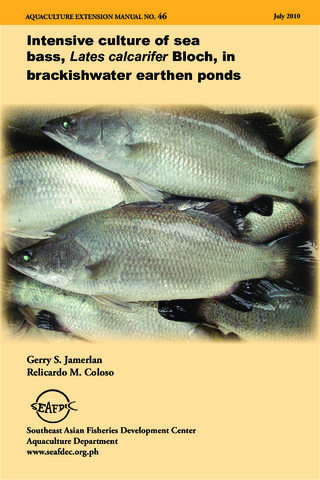
Intensive culture of sea bass, Lates calcarifer Bloch, in brackishwater earthen ponds
(Aquaculture Department, Southeast Asian Fisheries Development Center, 2010)An extension manual describing criteria for site selection, monoculture and polyculture operations including feeds and feeding, harvest, common diseases, economic analysis. -
Aquaculture system
(Secretariat, Southeast Asian Fisheries Development Center, 2008)A defining moment in the development of aquaculture was the demonstration that fish could be induced to spawn artificially. This finding, elaborated in Brazil in 1934, drove aquaculture forward by eliminating the need to ...