Collection, storage, transport, and acclimation of milkfish fry and fingerlings
Share
abstrak
The present methods of collecting fry and fingerlings involve filtration by mobile or stationary devices. The bottom topography of the fry ground, wind direction, and tidal fluctuations are the most important considerations in the design and construction of fry and fingerling catching gear. The behavior of young milkfish (Chanos chanos ) in the different environments where they are exploited determines the catching methods to be employed. Collection, handling, storage, and transport activities expose the fish to undue stress, which contributes to poor survival. The simple method of lowering the salinity of the water medium considerably reduces mortality. Prior acclimation history has significant effects on subsequent survival and adaptation. Although it appears that milkfish fry are more hardy than the fingerlings, both have the same capability for resisting subsequent environmental stress provided sufficient time is given for the fish to recover from previous stress.
Suggested Citation
Villaluz, A. C. (1984). Collection, storage, transport, and acclimation of milkfish fry and fingerlings. In J. V. Juario, R. P. Ferraris, & L. V. Benitez (Eds.), Advances in milkfish biology and culture: Proceedings of the Second International Milkfish Aquaculture Conference, 4-8 October 1983, Iloilo City, Philippines. (pp. 85-96). Metro Manila, Philippines: Published by Island Pub. House in association with the Aquaculture Department, Southeast Asian Fisheries Development Center and the International Development Research Centre.
Subjek

Taxonomic term

Koleksi
Related items
Showing items related by title, author, creator and subject.
-
Small-scale freshwater aquaculture development: Experiences from the Philippines on giant freshwater prawn, milkfish and tilapia
(Japan International Cooperation Agency, 2013-12)The Aquaculture Department of the Southeast Asian Fisheries Development Center (SEAFDEC/AQD) has been promoting a number of programs towards effective dissemination and adoption of science-based aquaculture technologies ... -
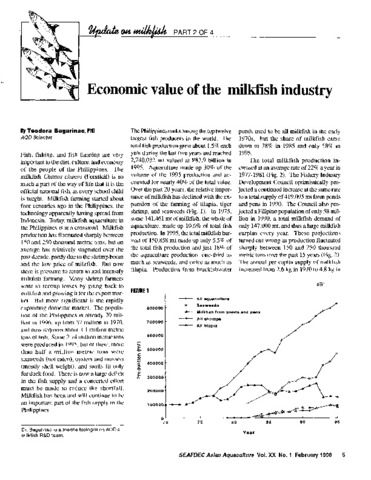
Economic value of the milkfish industry
(Aquaculture Department, Southeast Asian Fisheries Development Center, 1998)A brief description is given of the milkfish (Chanos chanos) farming industry in the Philippines. Over the past 20 years, the relative importance of milkfish has declined with the expansion of tilapia, tiger shrimp and ... -
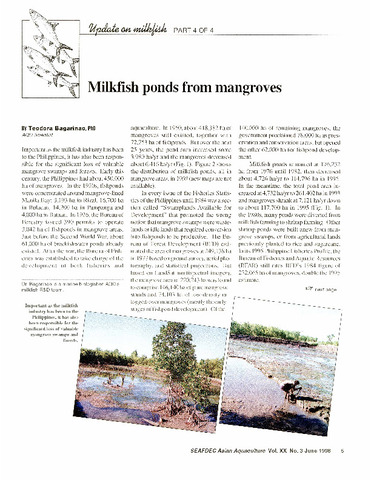
Milkfish ponds from mangroves
(Aquaculture Department, Southeast Asian Fisheries Development Center, 1998)