Integration of aquaculture and mangroves
ရှာဖွေ/ဖွင့်ပါ။
ရက်စွဲ
2007Page views
138Share
စိတ္တဇ
Southeast Asia has the highest concentration of mangroves and brackish water aquaculture ponds. This paper describes studies that integrate mangroves as biofilters, and as pen culture sites for mud crab farming. In one study, passing shrimp pond effluents through a natural mangrove stand reduced levels of TSS, sulfide, NH3-N and NO3-N by 18.7%–64.2%. Estimates show that 1.4–6.5 ha of mangroves are needed to assimilate nitrogen wastes from one hectare of shrimp pond. Mangrove biomass increase was 2.5 times greater with effluents compared to a control mangrove, although plant numbers remained similar. Present mud crab Scylla spp. farming still depends on raw (“trash”) fish and wild seed. To lessen such dependence, another study compared the stocking of hatchery vs wild juveniles, and feeding of pellet + raw fish (“trash fish”) vs fish alone. Preliminary results show that low-cost pellets can reduce raw fish requirement, and that hatchery crab juveniles need immediate feeding whereas wild crabs can subsist on natural mangrove productivity for one month. Mud crab pen culture is commercially viable but technological refinements and land tenure issues remain.
ဖော်ပြချက်
Abstract only.
Suggested Citation
Primavera, J. (2007). Integration of aquaculture and mangroves. Bulletin of Marine Science , 80(3), 931. http://hdl.handle.net/10862/6579
Taxonomic term
စုစည်းမှုများ စုစည်းမှုများ
- AQD Journal Articles [1249]
Related items
Showing items related by title, author, creator and subject.
-
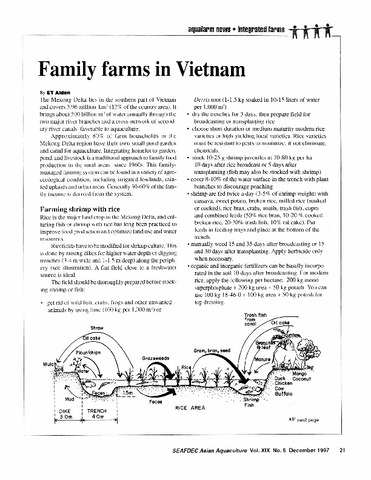
Family farms in Vietnam
(Aquaculture Department, Southeast Asian Fisheries Development Center, 1997) -
The Philippine aquaculture industry
(Aquaculture Department, Southeast Asian Fisheries Development Center, 1988)The aquaculture sector of the Philippine fishing industry registered the highest growth rate of 12.5% in 1977-1986. The contribution of aquaculture to the total fish production was equivalent to 24% in 1986 compared to ... -
Knowing Asian aquaculture and fisheries
(Aquaculture Department, Southeast Asian Fisheries Development Center, 1998-04)This article is the second of four parts.