Effects of restricted feeding rates on growth, production, and economics of Nile tilapia (Oreochromis niloticus) and giant freshwater prawn (Macrobrachium rosenbergii) polyculture in pond-based biofloc and traditional grow-out system

រកមើល / បើក
កាលបរិច្ឆេទ
2025-01-15Page views
1,403ទិន្នន័យមេតា
មើលកំណត់ត្រាលម្អិតនៃធាតុCited times in Scopus
Share
អរូបី
The combined effects of restricted feeding rates [50–75% apparent satiation (AS) and 100% AS] and culture systems [biofloc (BFT) and traditional pond system (TP)] on the growth, production, and economics of Nile tilapia-freshwater prawn polyculture were examined in a 2 × 2 factorial feeding trial for 120 days. Each treatment was carried out in triplicate following complete randomized design. Nile tilapia fingerlings (2.09 g) and freshwater prawn post larvae (PL20; 0.05 g) were stocked at an initial density ratio of 6:6 individuals/m2. Lower dissolved oxygen (DO) and higher Total Ammonia Nitrogen (TAN) and nitrite concentrations were observed in BFT system. Similarly, higher levels of DO were recorded in 50–75% AS-fed group, while TAN, nitrite, nitrate, and total suspended solids (TSS) were significantly higher at 100% AS-fed group. Culture system, feeding rate, and their interactions had significant effect on final body weight (FBW) and daily growth rate (DGR) of Nile tilapia. Lower FCR in Nile tilapia was noted in both BFT system and 50–75% AS-fed group. For freshwater prawn, the highest FBW and DGR were obtained in BFT system and fed 100% AS. However, survival rates and condition factor did not differ across all treatments for both species. Higher yield for both species and more large-size tilapia were obtained when fed at 100% AS. An increase in yield and significant improvement on the size distribution of prawns were also achieved in BFT system. Although both BFT and 100% AS have led to better performance, cost and return analysis have instead revealed better profitability using TP system and feeding rate of 50–75% AS. The lower cost of production in these treatments has economically compensated for the unfavorable growth, yield, and size distribution.
Suggested Citation
Dela Cruz, M., Aya, F., & Estante-Superio, E. (2025). Effects of restricted feeding rates on growth, production, and economics of Nile tilapia (Oreochromis niloticus) and giant freshwater prawn (Macrobrachium rosenbergii) polyculture in pond-based biofloc and traditional grow-out system. Aquaculture International , 33(2), 144. https://doi.org/10.1007/s10499-025-01833-z
ប្រធានបទ
Taxonomic term
បណ្តុំបណ្តុំ
- AQD Journal Articles [1249]
Related items
Showing items related by title, author, creator and subject.
-
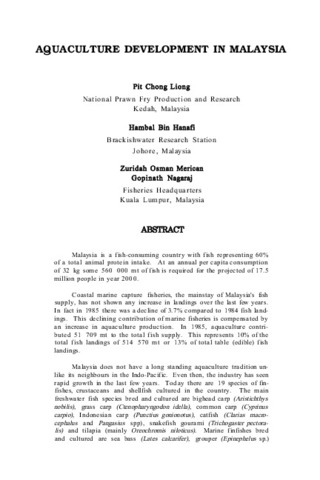
Aquaculture development in Malaysia
(Aquaculture Department, Southeast Asian Fisheries Development Center, 1988)Malaysia is a fish-consuming country with fish representing 60% of a total animal protein intake. At an annual per capita consumption of 32 kg some 560 000 mt of fish is required for the projected of 17.5 million people ... -
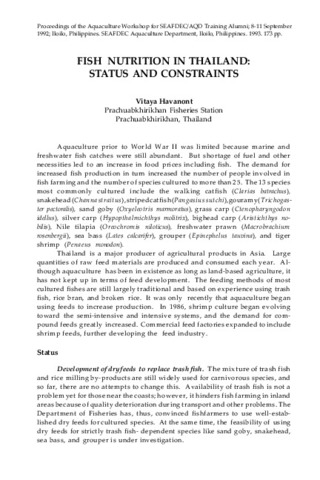
Fish nutrition in Thailand: Status and constraints
(Aquaculture Department, Southeast Asian Fisheries Development Center, 1993)Aquaculture prior to World War II was limited because marine and freshwater fish catches were still abundant. But shortage of fuel and other necessities led to an increase in food prices including fish. The demand for ... -
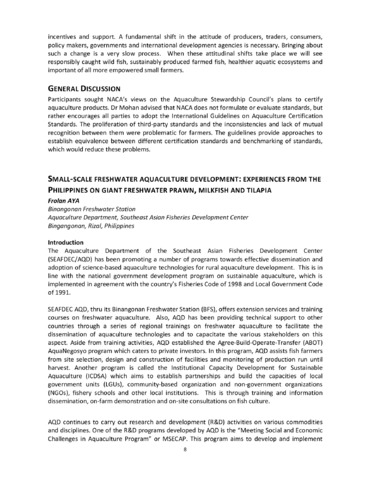
Small-scale freshwater aquaculture development: Experiences from the Philippines on giant freshwater prawn, milkfish and tilapia
(Japan International Cooperation Agency, 2013-12)The Aquaculture Department of the Southeast Asian Fisheries Development Center (SEAFDEC/AQD) has been promoting a number of programs towards effective dissemination and adoption of science-based aquaculture technologies ...