Mud crab culture
Share
អរូបី
Mud crabs are one of the most widely sought crustacean species that inhabit the estuarine areas and tidal rivers and creeks of the Asian and Indo-Pacific regions. Hailed as "food for the gods," the mud crab is recognized as a candidate species for culture in brackishwater ponds and/or other suitable impounded brackishwater environments.
In the past, mud crabs were a secondary species to cultured finfishes or crustaceans. Larvae entered ponds with incoming water and became trapped. Although conceived as a fishpond crop, the mud crab has also been considered a nuisance in ponds because it burrows into dikes and causes damage and leaks.
Farming of mud crab has been progressing rapidly due to a promising market and profitability.
With the availability of mud crab juveniles from the wild throughout the year and the recent development in hatchery technology, there is a strong indication that production of mud crabs on a commercial scale could be a lucrative industry.
The information presented here is based on the recently published extension manuals and literature on mud crab culture both in brackishwater ponds and pen enclosures in mangroves.
Suggested Citation
Baliao, D. D. (2000). Mud crab culture. In R. R. Stickney (Ed.), Encyclopedia of Aquaculture (pp. 548–552).
ប្រធានបទ

Taxonomic term

បណ្តុំបណ្តុំ
Related items
Showing items related by title, author, creator and subject.
-
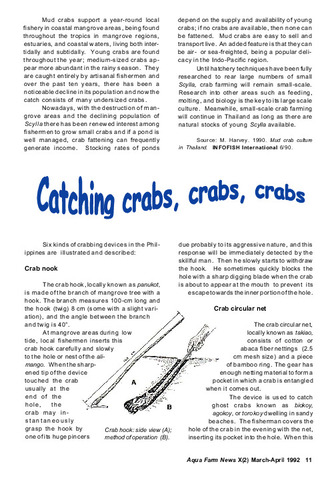
Catching crabs, crabs, crabs
(Aquaculture Department, Southeast Asian Fisheries Development Center, 1992) -
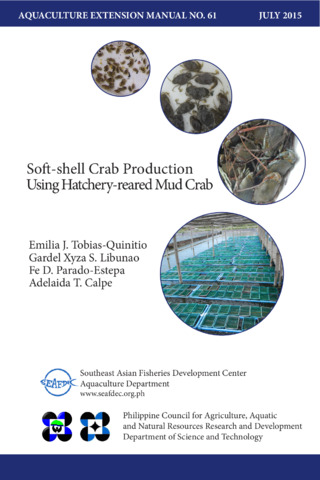
Soft-shell crab production using hatchery-reared mud crab
(Aquaculture Department, Southeast Asian Fisheries Development Center; Philippine Council for Agriculture, Aquatic and Natural Resources Research and Development (PCAARRD), 2015)"The production of soft-shell crabs is well established in other Asian countries but its sustainability is already being threatened due to the decreasing mud crab population in the wild where the seedstocks are sourced. ... -
Monosex culture of the mud crab Scylla serrata at three stocking densities with Gracilaria as crab shelter
(Australian Centre for International Agricultural Research, 1999)The effects of three levels of stocking density (0.5, 1.5 or 3.0/m2) and monosex culture (male or female) on the growth, survival and production of Scylla serrata were investigated. Juvenile crabs were stocked in 150 m2 ...