Effects of fiber in supplemental feeds on milkfish (Chanos chanos Forsskal) production in brackishwater ponds
Share
ບົດຄັດຫຍໍ້
The study explores the nutritive value of fiber in supplemental feeds for milkfish. The feeding rates were adjusted so that all treatments involved equal protein-N load (6 g·kg-1 fish/day), and varying energy and fiber loads. Rice hull provided the bulk of dietary fiber. Fresh chicken manure, containing 16% protein, served as control. Four 800-m2 earthen ponds divided into four compartments were used. Milkfish juveniles (29 g) were stocked at 7,000·ha-1. After three months of culture, milkfish growth and production and protein efficiency ratio were significantly higher (α = 0.05) in fed ponds than in manured ponds. Average yield and manure conversion ratio in manured ponds were 436 kg·ha-1 and 14.5, respectively. There was no significant difference in yields (600-624 kg·ha-1) between feed treatments. Fish exposed to low protein/33% fiber diet had a worse feed conversion ratio (5.8) than those exposed to high protein/15 or 24% fiber diets (3.6). The results indicate that energy was not limiting in the high fiber (24%) treatment compared to low fiber (15%), but additional fiber (33%) did not further improve growth; and fiber in low protein diets was utilized further as a direct or indirect source of energy. Thus, a low protein/high fiber diet can be an economical way of increasing milkfish production in brackishwater ponds.
Suggested Citation
Sumagaysay, N. S., & Chiu-Chern, Y. N. (1991). Effects of fiber in supplemental feeds on milkfish (Chanos chanos Forsskal) production in brackishwater ponds. Asian Fisheries Science , 4(2), 189-199. http://hdl.handle.net/10862/1358
ວິຊາ
Taxonomic term
Collections
- AQD Journal Articles [1249]
Related items
Showing items related by title, author, creator and subject.
-
Small-scale freshwater aquaculture development: Experiences from the Philippines on giant freshwater prawn, milkfish and tilapia
(Japan International Cooperation Agency, 2013-12)The Aquaculture Department of the Southeast Asian Fisheries Development Center (SEAFDEC/AQD) has been promoting a number of programs towards effective dissemination and adoption of science-based aquaculture technologies ... -
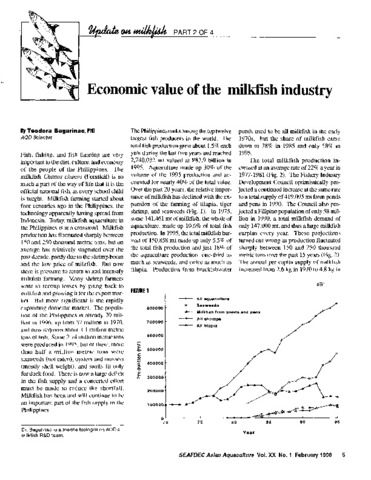
Economic value of the milkfish industry
(Aquaculture Department, Southeast Asian Fisheries Development Center, 1998)A brief description is given of the milkfish (Chanos chanos) farming industry in the Philippines. Over the past 20 years, the relative importance of milkfish has declined with the expansion of tilapia, tiger shrimp and ... -
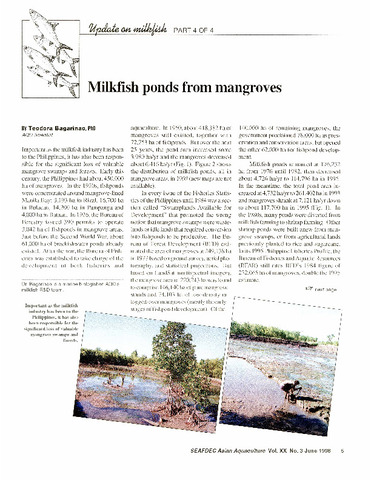
Milkfish ponds from mangroves
(Aquaculture Department, Southeast Asian Fisheries Development Center, 1998)