Nitrogen and phosphorus digestibility and excretion of different-sized groups of milkfish (Chanos chanos Forsskal) fed formulated and natural food-based diets
Share
Abstract
This study determined the digestibility of nitrogen and phosphorus, and the excretion rate of different-sized groups of milkfish fed a commercial diet, a SEAFDEC formulated diet or lab-lab (natural food-based diet). Fish (31.2–263.0 g) were stocked in 12 units of 300-L fibreglass tanks filled with aerated seawater. The postprandial total ammonia-nitrogen (TAN) and phosphate (PO4-P) excretion of fish were estimated from changes in TAN and PO4-P concentrations in water for 24 h. Digestibility was determined from the nitrogen, phosphorus and Cr2O3 content of the diets, and pooled faeces after the fish had been fed diets marked with chromic oxide. TAN excretion rate (mg TAN kg−1 fish day−1) was significantly lowest (P < 0.05) in medium to very big fish fed the lab-lab diet (60.8–124.4) and highest in small and medium fish fed the SEAFDEC diet (333.3–331.6) and small fish fed the commercial diet (280.1). Regardless of size, fish fed lab-lab excreted (mg PO4-P kg−1 fish day−1) significantly lower PO4-P (36.2) but did not differ with fish fed the commercial diet (64.8). Excretion rates decreased exponentially as fish weight increased but positively increased with feed ration. Excretion pattern of milkfish revealed two peaks: the first peak occurred 6 h after feeding and the second peak at 18 h for TAN and 21 h for PO4-P, coinciding with the start of the daylight hours. TAN and PO4-P excretion accounted for 20.5–34.6% of total N consumed and 18.7–42.6% of P consumed respectively. Approximately 27.9–42.5% of N consumed and 47.2–58.5% of P consumed were lost as faeces. Total nutrient losses were lower using the lab-lab diet (0.31 g N and 0.14 g P kg−1 fish) compared with the formulated diets (0.47–0.48 g N and 0.17–0.19 g P kg−1 fish); the losses decreased per kg of fish as fish size increased. Results suggest that the diet and size of fish influence wastage of N and P to the environment with greater losses in small fish and when artificial diets are used. Such measurements will provide valuable information for the preparation of N and P budgets for milkfish in grow-out systems.
Suggested Citation
Sumagaysay-Chavoso, N. S. (2003). Nitrogen and phosphorus digestibility and excretion of different-sized groups of milkfish (Chanos chanos Forsskal) fed formulated and natural food-based diets. Aquaculture Research , 34(5), 407-418. https://doi.org/10.1046/j.1365-2109.2003.00824.x
Paksa

Taxonomic term

Mga koleksyon
- AQD Journal Articles [1249]
Related items
Showing items related by title, author, creator and subject.
-
Small-scale freshwater aquaculture development: Experiences from the Philippines on giant freshwater prawn, milkfish and tilapia
(Japan International Cooperation Agency, 2013-12)The Aquaculture Department of the Southeast Asian Fisheries Development Center (SEAFDEC/AQD) has been promoting a number of programs towards effective dissemination and adoption of science-based aquaculture technologies ... -
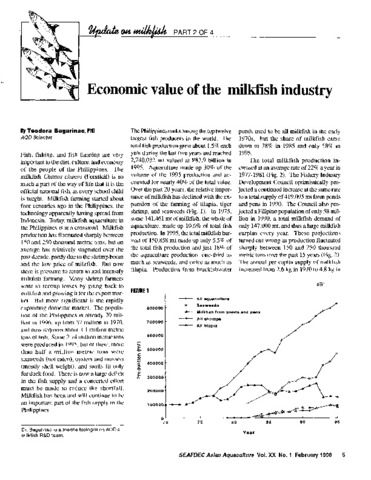
Economic value of the milkfish industry
(Aquaculture Department, Southeast Asian Fisheries Development Center, 1998)A brief description is given of the milkfish (Chanos chanos) farming industry in the Philippines. Over the past 20 years, the relative importance of milkfish has declined with the expansion of tilapia, tiger shrimp and ... -
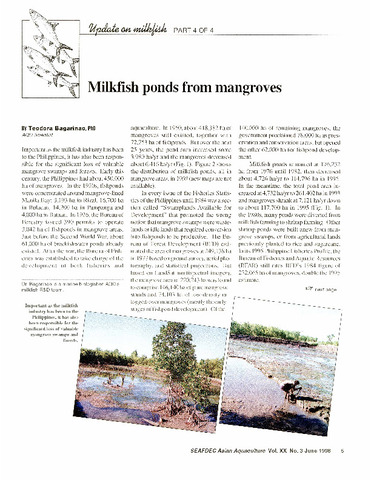
Milkfish ponds from mangroves
(Aquaculture Department, Southeast Asian Fisheries Development Center, 1998)